
Being Bendy Doesn’t Make You Weak!
by Dr. Sarah Joy Stuckart, PT, DPT, CD
Are you hypermobile? Do you deal with chronic pain? Are you “double-jointed”? Do you do party tricks with your joints that freak people out? Have you felt like your body was “too complicated” for physical therapists to figure out?
These are common things people tell us!
Hypermobility as a kid can look like being good at gymnastic or contortion-type movements. It can look like doing party tricks with your joints, making your fingers bend backward or putting your foot behind your head. It can look like intense growing pains, or even severe or chronic pain. It can look like dizziness and having difficulty with sports. And because it can look many different ways, it often gets missed. People can be dismissed as having growing pains, anxiety, or trying to get out of things. But hypermobility is real, and it affects the whole body.
Systemic joint hypermobility is caused by issues with collagen. These issues mean that in people who are hypermobile, their collagen isn’t as strong as someone without hypermobility. So where is collagen in the body? Well, it’s everywhere! Collagen is in your skin, bones, muscles, organs, blood vessels, etc. Because of this, hypermobility can affect multiple body systems, not just the joints. Hypermobile people can experience pain, dizziness, heart rate issues, arthritis, digestive issues, vision issues, etc. And everyone is different!
Are you hypermobile? Let’s check!
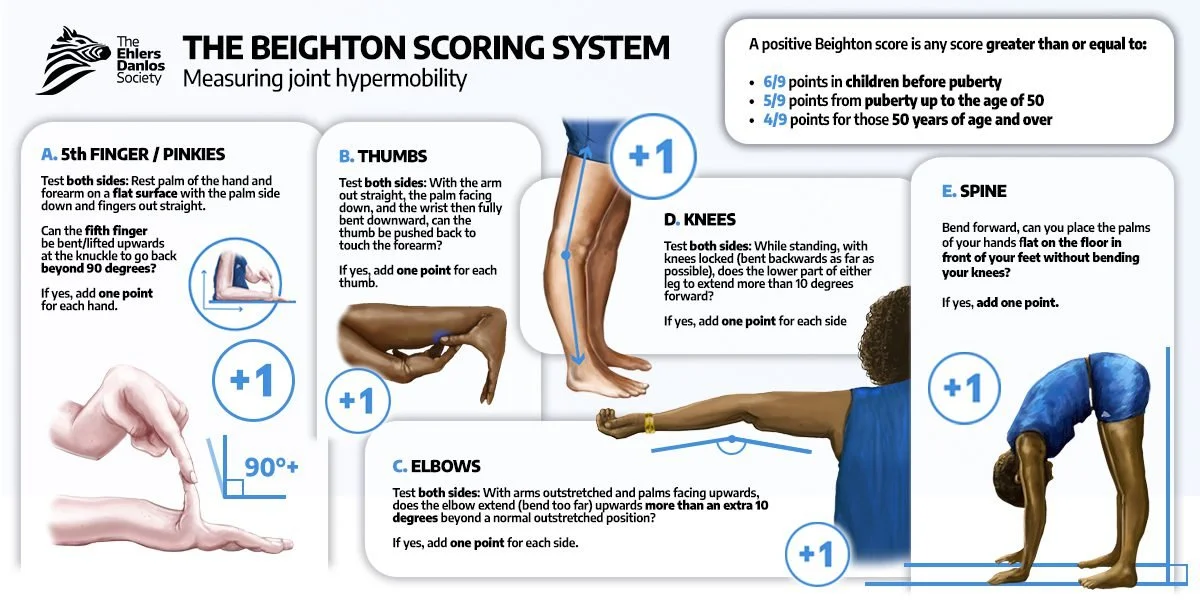
Above is the Beighton Scoring System. It’s a points-based system that measures joint mobility. If you have a positive Beighton score (greater than 5 out of 9 points in adults), then you’re considered to be systemically hypermobile. There are additional tests that certain medical providers can do to determine if that hypermobility is due to Ehlers-Danlos Syndrome (EDS).
If you’ve been dealing with hypermobility, chronic pain, and fatigue, chances are you’ve felt weak. But you also probably have tense muscles that don’t want to let go. That’s because your muscles are working overtime to try to stabilize your joints! The trouble is, most people will tell you to stretch if your muscles are tense, but that doesn’t help if you’re hypermobile. What you really need is to release tension, then build strength. That’s where physical therapy comes in. Getting massage helps release the tension, but things tense up again as soon as you start moving, because your body is still looking for stability. Lifting weights builds strength, but usually in the big muscles, not in the smaller ones that need to stabilize your joints. A physical therapist who specializes in hypermobility is the best person to find the right combination of these treatments for you and your body, so you can move better and be pain-free.
If you’d like a free discovery call with one of our doctors of physical therapy, click “Book Now” above and we’ll share how we can help you.
